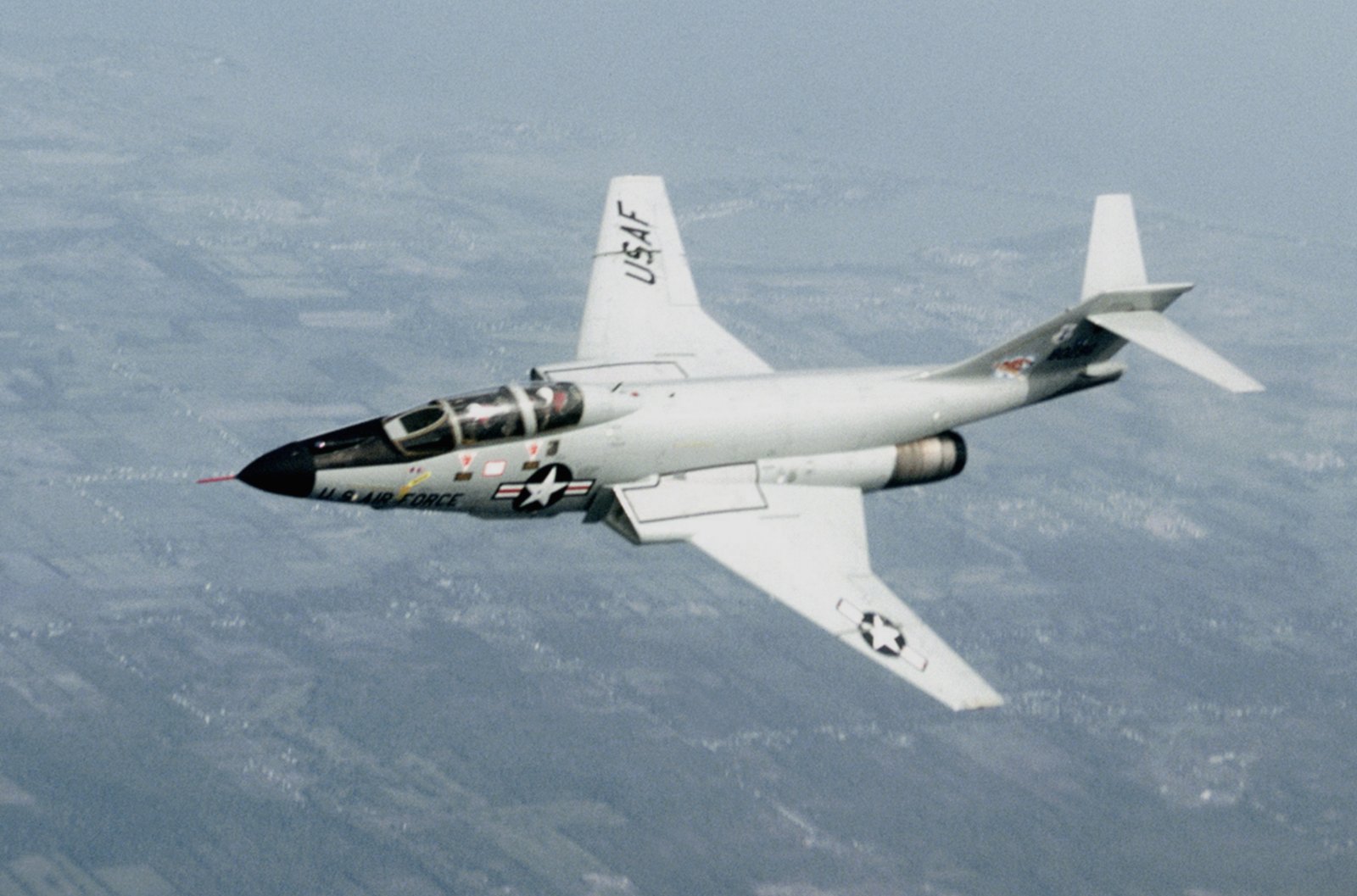
McDonnell F-101B Voodoo
Click image to view in high resolution.
The McDonnell F-101 Voodoo is a supersonic jet fighter designed and produced by the American McDonnell Aircraft Corporation.
Development of the F-101 commenced during the late 1940s as a long-range bomber escort (then known as a penetration fighter) for the United States Air Force's (USAF) Strategic Air Command (SAC). It was also adapted as a nuclear-armed fighter-bomber for the USAF's Tactical Air Command (TAC), and as a photo reconnaissance aircraft based on the same airframe. On 29 September 1954, it performed its maiden flight. The F-101A set a number of world speed records for jet-powered aircraft, including fastest airspeed, attaining 1,207.6 miles (1,943.4 km) per hour on 12 December 1957.[1]
Delays in the 1954 interceptor project led to demands for an interim interceptor aircraft design, a role that was eventually won by the F-101B Voodoo. This role required extensive modifications to add a large radar to the nose of the aircraft, a second crew member to operate it, and a new weapons bay using a rotating door that held its four AIM-4 Falcon missiles or two AIR-2 Genie rockets hidden within the airframe until it was time to be fired. The F-101B entered service with USAF Air Defense Command in 1959 and the Royal Canadian Air Force (RCAF) in 1961. While the Voodoo was a moderate success, it may have been more important as an evolutionary step towards its replacement in most roles, the F-4 Phantom II, one of the most successful Western fighter designs of the 1950s; the Phantom would retain the twin engines, twin crew for interception duties, and a tail mounted well above and behind the jet exhaust, although it was an evolution of the F3H Demon while the Voodoo was developed from the earlier XF-88 Voodoo.
The Voodoo's career as a fighter-bomber was relatively brief, but the reconnaissance versions served for some time. Along with the US Air Force's Lockheed U-2 and US Navy's Vought RF-8 Crusaders, the RF-101 reconnaissance variant of the Voodoo was instrumental during the Cuban Missile Crisis and saw extensive service during the Vietnam War.[2] Interceptor versions served with the Air National Guard until 1982, and in Canadian service, they were a front line part of NORAD until their replacement with the CF-18 Hornet in the 1980s. The type was operated in the reconnaissance role until 1979. US examples were handed off to the USAF Air National Guard where they were operated until 1982. The RCAF Voodoos were in service until 1984. Learn More
Aircraft Specifications
Country: United States
Manufacturer: McDonnell Aircraft Corporation
Year: 1957
Number Built: 807
Active: Yes
Powerplant: 2 x Pratt & Whitney J57-P-55 afterburning turbojet engines
Number of Crew: 2
Length: 20.55m
Height: 5.49m
Vertical Stabilizers: 1
Wingtype: Fixed
Wingspan: 12.09m
Wing Area: 34.20m²
Gross Weight: 20,713kg
Max Speed: 1,825 km/h (Mach 1.48)
Range: 2,450km
Thrust to Weight Ratio: 0.74