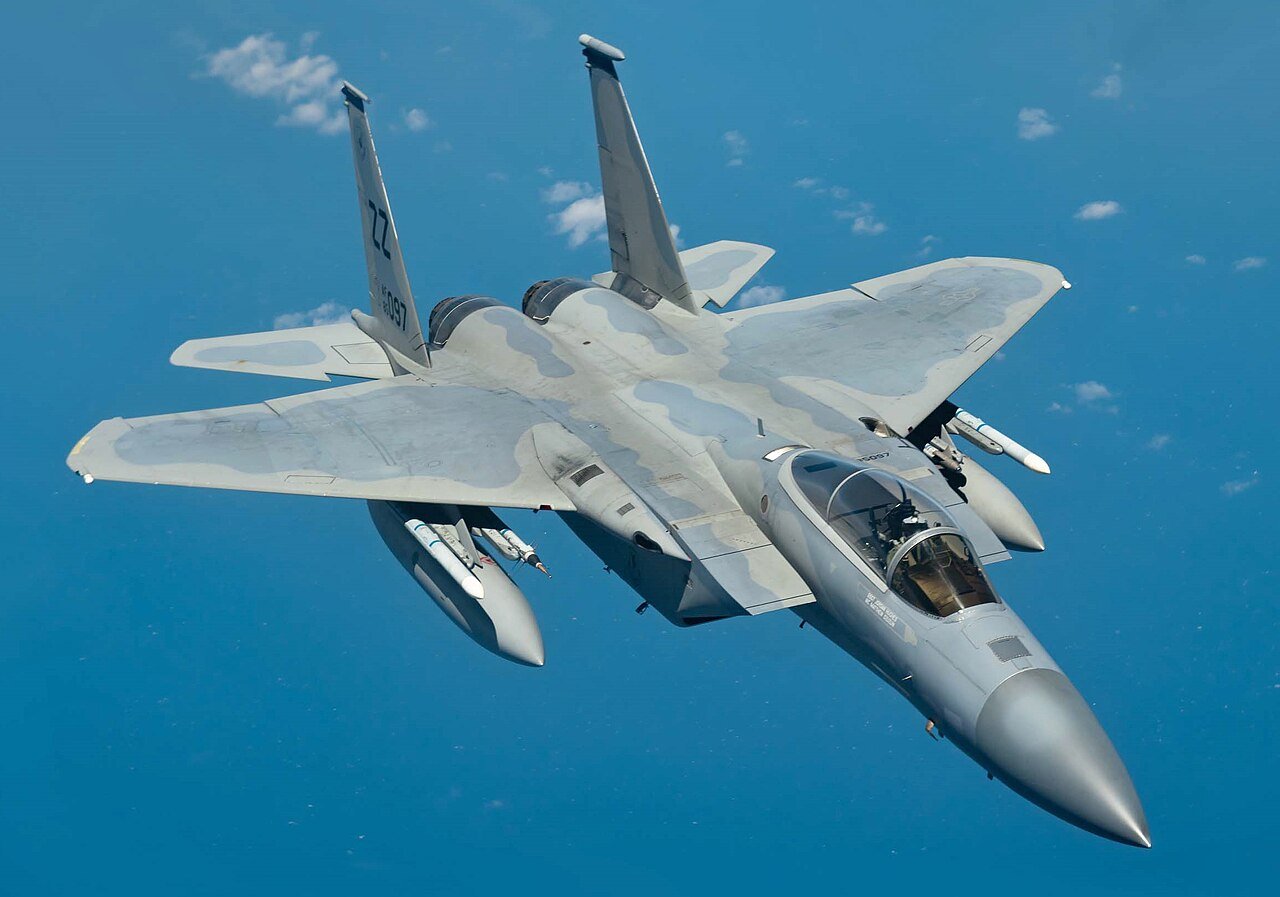
McDonnell Douglas F-15 Eagle
Click image to view in high resolution.
The McDonnell Douglas F-15 Eagle is an American twin-engine, all-weather tactical fighter aircraft designed by McDonnell Douglas (now part of Boeing). Following reviews of proposals, the United States Air Force (USAF) selected McDonnell Douglas's design in 1969 to meet the service's need for a dedicated air superiority fighter. The Eagle first flew in July 1972, and entered service in 1976. It is among the most successful modern fighters, with over 100 victories and no losses in aerial combat, with the majority of the kills by the Israeli Air Force.
The Eagle has been exported to many countries including Israel, Japan, and Saudi Arabia. Although the F-15 was originally envisioned as a pure air superiority fighter, its design included a secondary ground-attack capability that was largely unused. It proved flexible enough that an improved all-weather strike derivative, the F-15E Strike Eagle, was later developed, entered service in 1989 and has been exported to several nations. Several additional F-15 variants have been produced.
The USAF had planned to replace all of its air superiority F-15s with the F-22 Raptor by the 2010s, but the severely reduced F-22 procurement forced the service to operate some F-15C/Ds until 2026 and replace them with newly built F-15EX Eagle II in order to retain adequate number of air superiority fighters. The F-15E Strike Eagle is expected to continue operating in the USAF into the 2030s. The F-15 is in service with numerous countries, with production of enhanced variants ongoing. Learn More
Aircraft Specifications
Country: United States
Manufacturer: McDonnell Douglas
Year: 1976
Number Built: 1198
Active: Yes
Powerplant: 2 x Pratt & Whitney F100-PW-220 afterburning turbofans
Number of Crew: 1
Length: 19.43m
Height: 5.64m
Vertical Stabilizers: 2
Wingtype: Fixed
Wingspan: 13.06m
Wing Area: 56.50m²
Gross Weight: 20,185kg
Max Speed: 2,655 km/h (Mach 2.15)
Range: 1,965km
Thrust to Weight Ratio: 1.07
Video:
Src: https://www.youtube.com/watch?v=osFNW14QBHw